Nathan Guzman
Mapping, listening, and building tools at the intersection of the built environment and the people who live in it.
I'm Nathan Guzman, an incoming Master of City and Regional Planning student at Georgia Tech. For the past four years at finEQUITY, a nonprofit serving people returning home from incarceration, I kept hearing the same thing: the hardest parts of reentry traced back to the built environment — to transit that didn't run, to neighborhoods that no longer recognized the people coming back to them, to community spaces that had quietly disappeared. The projects below are how I've been learning to work on that — through GIS, qualitative research, and small tools that try to make the built environment, and the people in it, more legible to one another.
Selected work
Tap a tile to jump down
-
1940neighbors.nyc
Mapping 1940 NYC Census records to the buildings where people actually lived.
- GIS
- Historical Research
-
CheckPoint
A scavenger hunt platform that turned a Brooklyn farewell into a city-wide game.
- Civic Tech
- Placemaking
-
Locale
Discover the businesses within walking distance of where you live.
- Local-first
- OpenStreetMap
-
Backyard Bird Tracker
A 3-tap workflow for contributing casual bird counts to eBird.
- Citizen Science
- PWA
-
Senior Thesis + Documentary
Two years of ethnographic fieldwork on felonism, communicated through film.
- Ethnography
- Documentary
-
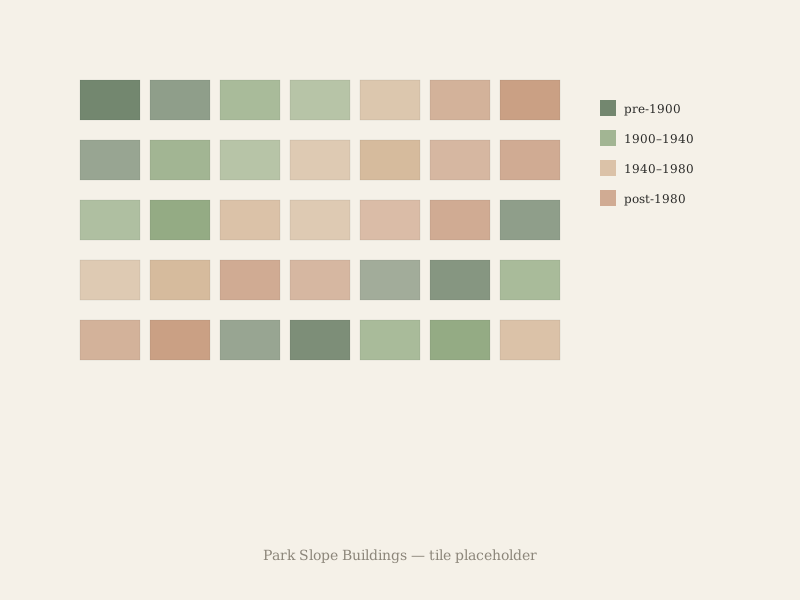
Park Slope Buildings
A static map of Park Slope buildings by year of construction.
- Cartography
- NYC Open Data
1940neighbors.nyc
Mapping 1940 NYC Census records to the buildings where people actually lived.
- Tools
- QGIS · Python · NYC Open Data · Ancestry.com · qgis2web
- Role
- Solo, ongoing
- Year
- 2023–present
1940neighbors.nyc is a reproducible pipeline for turning handwritten 1940 Census manuscripts into spatial data, joined to the present-day building footprints where those people lived. To date, I’ve mapped seven enumeration districts across NYC, representing hundreds of buildings and thousands of individual records.
The technical work involves text-scraping handwritten records via Ancestry, normalizing street names against NYC’s authoritative address data, custom Python scripts to clean house numbers and join records to Building Identification Numbers (BIN), and a QGIS workflow that produces interactive web maps distinguishing buildings constructed before 1940 — where you’re looking at the same physical structure people lived in — from those built after.
The project includes a public “Request Your Block” form, inviting others to ask me to map their neighborhood. The full methodology is documented in a 5-page process guide so the work is reproducible by anyone with QGIS and patience.
I think of this as historical GIS, but really it’s a tool for reading the built environment. Most of the buildings in these districts are still standing. Walking past them with the 1940 layer pulled up changes what you see: who lived there, what they did for work, who they lived with, where they came from. It’s a small attempt to make the neighborhoods we move through every day legible as places with continuous, specific histories — the kind of context planners and residents both need when decisions get made about what stays and what changes.
"Letting people see who lived in their building 85 years ago, by name."
Demo video placeholder — will upgrade to live phone-iframe in v1.5 once demo mode ships.
CheckPoint
A scavenger hunt platform that turned a Brooklyn farewell into a city-wide game — and is now a tool anyone can use.
- Tools
- React 19 · TypeScript · Vite · Tailwind · Supabase · Mapbox GL · Google Maps API · Vercel · PWA
- Role
- Solo, built with Claude Code
- Year
- 2025
CheckPoint started as a farewell to Brooklyn — a scavenger hunt where I seeded 40+ locations across the borough that were meaningful to me, each with a clue, a category, and a handwritten message about why the place mattered. My friends formed teams and spent an afternoon racing across Brooklyn to find them. When they arrived at the right spot, GPS confirmed their location, confetti filled the screen, and the place’s name and personal message were revealed.
But it became more than the event. I built it as a general-purpose platform — anyone can host their own scavenger hunt anywhere, with their own places, their own clues, their own people. The admin panel handles the chaos of a live outdoor event: timer controls, manual check-in overrides for when GPS fails, batch distance calculations via Google Maps, double-confirmation for destructive operations.
The technical depth came from designing for real-world conditions. GPS is unreliable; the app knows it and shows troubleshooting steps when a check-in fails. Mobile browsers drop WebSocket connections unpredictably, so the leaderboard uses real-time sync with a polling fallback. The four-factor scoring algorithm rewards rarity and distance, with a 1.5x multiplier when teams stay together — creating an actual strategic dilemma between covering ground and earning multipliers.
After the game ends, players can export every discovered place as a KML file to save in Google My Maps. A scavenger hunt that happened on one afternoon becomes a permanent layer on their personal map of a place.
The reason I keep building on it is the underlying premise: most of the third places and community-serving spaces that make a neighborhood feel like one don’t show up in the algorithmic stack, and they’re the first things to go when they’re not noticed. CheckPoint is a small, playful way to put them back on people’s mental maps. A planned “lifestyle” version is in the works, where the gamification recedes and people can simply share meaningful places with friends.
"It's not a product. It's a love letter with GPS coordinates."
Demo video placeholder — will upgrade to live phone-iframe in v1.5 once demo mode ships.
Live iframe pending default-address handling. Falls back to a poster screen until then.
Locale
Discover the businesses within walking distance of where you live.
- Tools
- React · TypeScript · OpenStreetMap (Overpass API) · Local-first storage · PWA
- Role
- Solo, built with Claude Code
- Year
- 2025
Locale pulls every business within a configurable walking radius of your address, sourced from OpenStreetMap. You can set a home address, browse what’s around you, and track which places you’ve visited. It’s local-first — your data lives on your device, not on a server.
I built it because I wanted a tool that pushed against algorithmic discovery — no recommendations, no rankings, no “for you” feed. Just the actual map of what’s nearby, organized by category and walking distance, encouraging people to spend time and money in the businesses on their own block rather than the ones an algorithm surfaces.
It’s a small piece of civic technology in the quietest sense: a walkability tool that makes the local economy legible without intermediating it. The same condition that makes a neighborhood feel alive — that you can get most of what you need on foot — is what Locale tries to put in front of people, one address at a time.
Live iframe pending default-address handling. Falls back to a poster screen until then.
The export pipeline is built; the end-to-end eBird CSV import flow is being validated now.
Backyard Bird Tracker
A 3-tap workflow for contributing casual backyard bird counts to eBird's global dataset.
- Tools
- React · TypeScript · Vite · Tailwind · Supabase · eBird API · Wikipedia API · PWA
- Role
- Solo, built with Claude Code
- Year
- 2026
eBird is the gold standard for global bird observation data, used by researchers and conservationists worldwide. But submitting a checklist requires navigating multiple screens, manually searching species names, and filling in metadata. For someone who just wants to step outside and count the birds at their feeder, the friction is high enough to discourage regular participation.
Backyard Bird Tracker reduces the session to tap-to-count. The species grid is ranked by how likely each bird is to appear in your region right now, based on eBird’s regional frequency data. You tap a card to count, tap again to count more. When you’re done, you export a CSV formatted exactly to eBird’s import specification, and your casual count joins the global dataset.
The app is offline-capable, installable as a PWA, and uses GPS auto-detection to localize the species list. It’s a small piece of community-data infrastructure — narrowing the gap between citizen-science systems and the people who could be contributing to them but currently aren’t. The same instinct that drives the planning work: lower the friction between formal data systems and the everyday people whose observations actually populate them.
The export pipeline is built; the end-to-end eBird CSV import flow is being validated now.
Senior Thesis + Documentary
Two years of ethnographic fieldwork on felonism, communicated through a documentary film.
- Tools
- MAXQDA · Ethnographic interviews · Video production
- Role
- Solo research, supervised by Prof. Gabriel Torres-Colón
- Year
- 2020–2021
For my senior honors thesis at Vanderbilt, I conducted 22 ethnographic interviews with Vanderbilt undergraduates and Edgehill neighborhood residents in Nashville, exploring how felonism — the placement of social, economic, and political disadvantage on people with prior felony convictions — is communicated through family and community discourse.
The methodological work was substantial: two semesters of fieldwork, MAXQDA-coded qualitative analysis, original framing of how informal discourse reproduces formal exclusion. But the academic findings weren’t the only output. I produced an ethnographic documentary, America: Home of the Second Chance?, profiling Calvin “Fridge” Bryant, a community leader in Middle Tennessee who shares his life story growing up in Edgehill and his experiences with the collateral consequences of a felony conviction.
The film isn’t a summary of the academic research — it’s an artistic response, intended to widen the conversation beyond the academic audience. The thesis received highest honors in my major.
Edgehill is also the neighborhood that anchored my freshman-year work on Jefferson Street and I-40 — the same place I came back to as a senior, asking different questions. The two projects bracket the through-line of my undergraduate work: how the built environment, public policy, and community discourse jointly shape who gets to belong in a place.
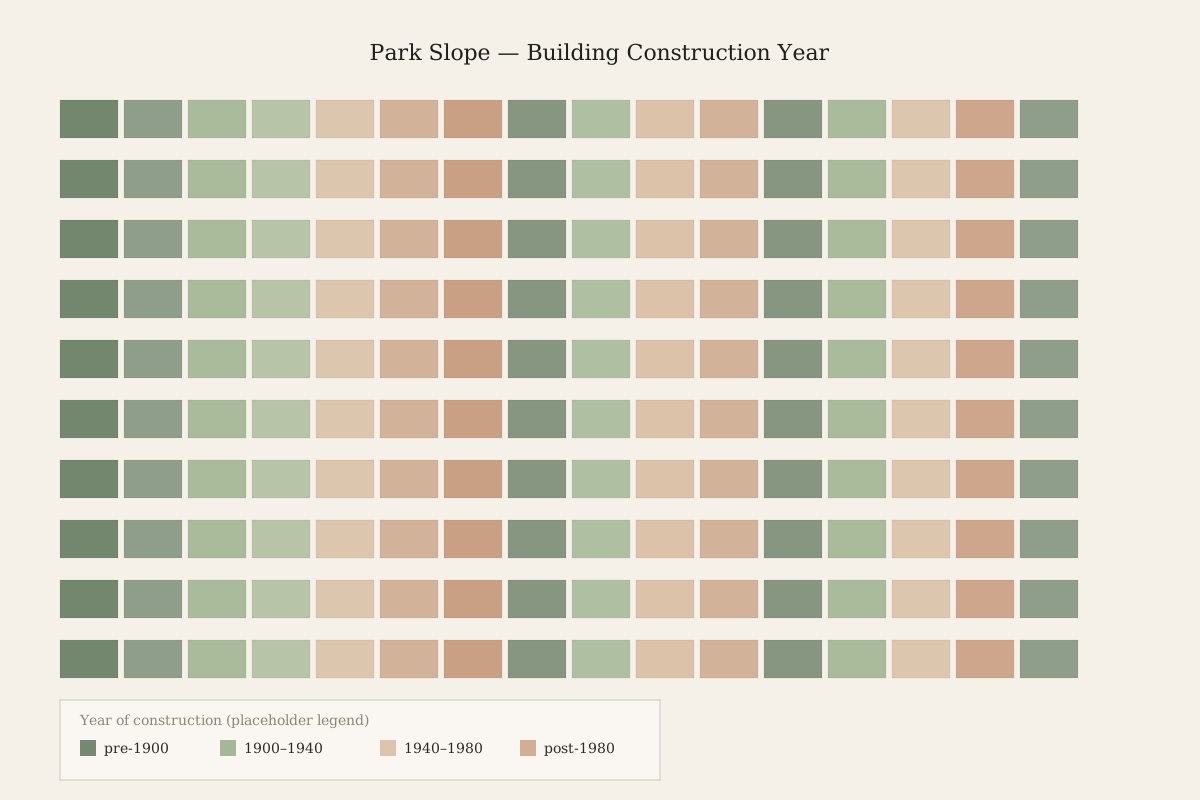
Interactive version in progress.
Park Slope Buildings
A static map of Park Slope buildings by year of construction.
- Tools
- QGIS · NYC Open Data (Building Footprints)
- Role
- Solo, personal exploration
- Year
- 2023
Before starting the 1940neighbors project, I was already exploring NYC building data out of curiosity about my own neighborhood. This static map of Park Slope colors every building by its year of construction, drawn from NYC Open Data’s building footprint dataset.
It’s a small piece of exploratory cartography — a personal map I made because I wanted to see the age of the buildings I walked past every day, and what the rhythm of construction looked like across a neighborhood that mostly reads as uniform brownstone. It was also the warm-up that convinced me building footprints were the right unit to organize the 1940neighbors work around. An interactive version is in progress.
Interactive version in progress.
Side projects
Smaller things, still useful
-
Transaction Reconciliation App
A two-person household expense reconciliation tool built on top of Google Sheets.
Next.js · Google Sheets API · Vercel -
Timeless Timer
A minimalist PWA that hides the countdown. Built to reduce timer anxiety.
Vanilla JS · Cloudflare Workers · Durable Objects
About
Based in Atlanta
I studied at Vanderbilt, where I majored in American Studies with highest honors and minored in Economics. My first serious encounter with planning came freshman year, in a seminar called Walking in Nashville: I spent the semester on Jefferson Street, tracing how the construction of I-40 sliced through what had been the commercial and cultural spine of Black Nashville. That project — and the People's Guide to Nashville it fed into — set the questions I've been working on ever since: how the built environment carries memory, and who gets erased when it changes.
After college I spent four years at finEQUITY, a nonprofit serving people returning home from incarceration. I came in to help build financial-empowerment programming and ended up doing a lot of listening. The clients I worked with kept describing the same things in different words — bus routes that didn't exist, neighborhoods they no longer recognized, third places that had closed. Those conversations are what moved me from adjacent work into planning itself, with a focus on multimodal transportation, urban design and placemaking, and the community-serving spaces that make a neighborhood feel like one.
I'm starting Georgia Tech's MCRP program in Fall 2026 and am actively looking for a Graduate Research Assistantship aligned with that work — particularly in GIS, transportation equity, or community-engaged research.
A note on the technical work: I don't have a formal coding background. I use Claude Code as a build partner on the more technical projects below, which lets me ship tools that would otherwise be out of reach. The research questions, design decisions, and judgment calls are mine; the implementation is collaborative.
Get in touch
I'm actively looking for a Graduate Research Assistantship at Georgia Tech's MCRP program for Fall 2026 — especially in GIS, transportation equity, or community-engaged research — as well as planning and civic-tech roles. If anything here resonates, I'd love to hear from you.